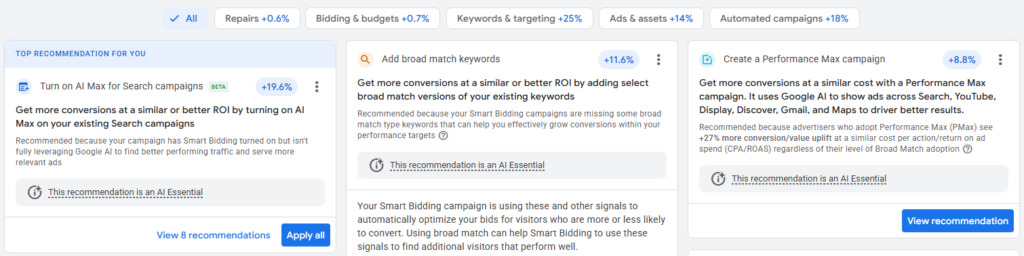
Log into almost any Google Ads account today, and one of the first things that will grab your attention is the Optimisation Score. Ranging from 0% to 100%, this is designed to show you how well Google thinks your campaign is set up. Right next to it, you’ll find a long list of recommendations, each with a bright blue ‘Apply’ button promising to boost your score – and your performance – with a single click.
For many busy online business owners and in-house marketers, the temptation is obvious. As AI becomes more popular, it feels like having an automated, data-driven co-pilot checking over your shoulder to make sure everything is running smoothly.
However here at Aillum, we manage a lot of high-performing paid ad campaigns across the UK, and if there is one thing we’ve learned, it’s that a 100% optimisation score does not always mean a 100% successful Google Ads campaign.
Google’s machine learning is incredibly smart, but it operates in a bit of a bubble. While the algorithm is great at reading data points, it doesn’t understand your specific online business goals, what your profit margins are or how valuable your lead generation is, or your day-to-day operational constraints. Blindly clicking ‘Apply’ on every automated suggestion can quickly cause you to lose control of your settings, reduce your traffic quality, and lead to a lot of wasted ad spend.
To get the best results from your business online with PPC marketing, it helps to know how to separate genuine account hygiene from suggestions that are mostly built to benefit Google. Here is our realistic guide to the good, the bad, and the costly options hiding inside your Google Ads recommendations.
What is the Google Ads Optimisation Score?
Simply put, the optimisation score is an estimated look at how well your Google Ads account is configured to perform. Google looks at your historical data, settings, and status to generate a percentage score.
If your optimisation score is sitting at 70%, Google will show you a handful of changes you can make to increase that remaining 30%. However, it’s vital to remember that this score is entirely based on Google’s automated recommendations. It doesn’t know if you have a strict limit on your budget, if you’re only looking to push certain products, or if a specific type of lead isn’t actually profitable for your sales team. A lower score with highly targeted, profitable keywords will always serve your business better than a 100% score that brings in irrelevant clicks.
The Good: Google Ads Recommendations That Are Actually Useful
Google’s recommendations are not inherently bad, they mainly lack understanding of your advertising objectives and limitations. In fact, some of them can act as a digital safety net, such as catching simple human errors or highlighting data insights that would usually take you hours of manual analysis to track down.
When you are reviewing your account, these are the recommendations that are genuinely useful and worth keeping an eye on:
- Conflicting Negative Keywords: This is a great technical safeguard. Over time, as your negative keyword lists grow, it is incredibly easy to accidentally add a negative term that blocks a live, high-performing keyword you actually want to bid on. Google flags these conflicts nearly instantly, ensuring your ads don’t accidentally stop running.
- Removing Redundant Keywords: If you have the exact same keyword in the same match type sitting inside different ad groups, you are essentially competing against yourself. Google’s recommendation to clean these up keeps your data consolidated and your account clean and tidy.
- Fixing Broken Tracking and Setup Alerts: Whether a conversion tag has stopped firing because of a recent website update, or the platform is suggesting you set up Enhanced Conversions, these alerts are highly beneficial. Accurate data is the foundation of any successful PPC Management strategy, and these prompts keep your tracking healthy.
- Adding Observation Audiences: Google will often suggest adding in-market or affinity audiences to your search campaigns in “Observation” mode. This is a valuable change, as it doesn’t change who sees your ads or alter your budget; it simply gathers data on the types of people who convert, giving you valuable insights for future manual tweaks, such as bidding up or down for specific audiences, or targeting a niche audience directly.
The Bad: Autopilot Traps That Take Away Your Control
While the technical hygiene recommendations help protect your account, other Google Ads suggestions will try to take the steering wheel completely out of human hands. These recommendations are driven by a one-size-fits-all approach to automation, which frequently results in messy targeting for online businesses.
The Danger of the ‘Auto-Apply’ Blanket
One of Google’s biggest pushes lately is trying to persuade advertisers to opt into “Auto-Apply Recommendations” features. By turning this on, you give Google’s algorithm permission to change your match types, inject new keywords, and alter your bidding configurations overnight without a human ever reviewing it.
For any business that needs to keep tight control over their brand messaging and budget, this is a massive risk. It completely removes your oversight, turning your dedicated marketing budget into an automated testing ground.
Display Network Expansion on Search Campaigns
Another Google Ads recommendation that regularly catches business owners out is the prompt to “Extend your reach with the Google Display Network”. On the surface, this sounds harmless enough, but the intent profiles of Search and Display are completely opposite.
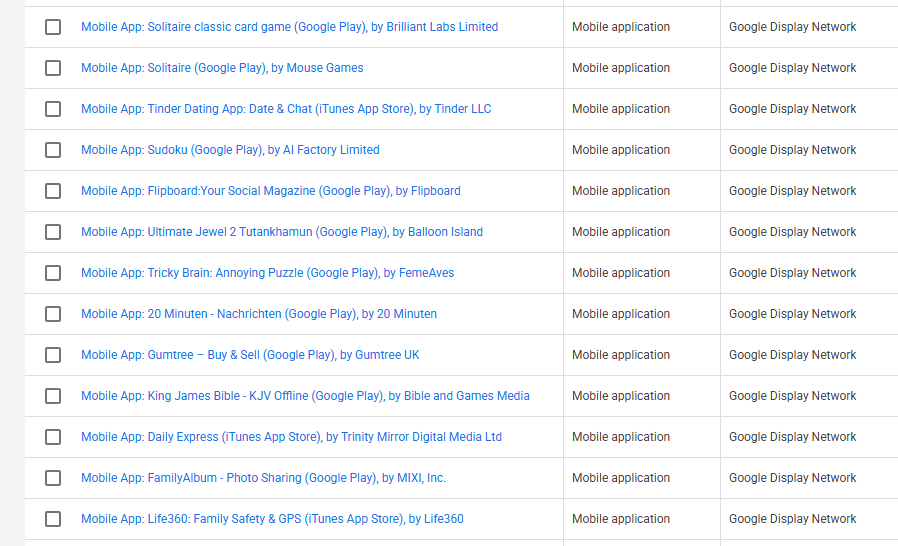
Search advertising captures users with active intent – they are actively looking for a business like yours at that exact moment. The Google Display Network, on the other hand, places banner ads in front of users who are passively browsing blogs on websites or playing mobile games via mobile apps.
Merging the two within a search campaign usually leads to a flood of accidental clicks from mobile apps, rapidly draining your budget and leading to skewed reporting. The Display Network is great for lots of impressions, but this results in a significantly lower CTR compared to Search-only campaigns. Combining these by implementing a recommendation can make your original Search Campaign suddenly look as if it’s performing poorly.
Premature Smart Bidding Prompts
Machine learning algorithms need a lot of historical data to work well, usually at least 30 conversions recorded in Google Ads, over a 30 day period (at least 1 per day on average) at the bare minimum. Despite this, Google regularly recommends switching campaigns to automated Smart Bidding strategies – like Target CPA (Cost Per Acquisition) or Target ROAS (Return on Ad Spend) – far too early in a campaign’s lifecycle.
If your campaign hasn’t yet established a steady, reliable stream of conversions, switching to these algorithms can stall your campaigns. Without enough data to learn from, the machine learning in Google Ads can’t predict user behaviour accurately, often causing it to stop showing your ads altogether or wasting ad spend by showing ads while it’s trying to learn inefficiently.
The Costly: Recommendations Geared Towards Spending More Money
Something easily forgotten, and is always worth remembering, is that at the end of the day Google is a business. A big portion of its recommendations are designed to increase ad spend under the guise of growing your online presence. When a recommendation directly asks you to increase budgets or broaden your targeting, you need to look at these recommendations very carefully.
The Constant Push to Raise Your Budget
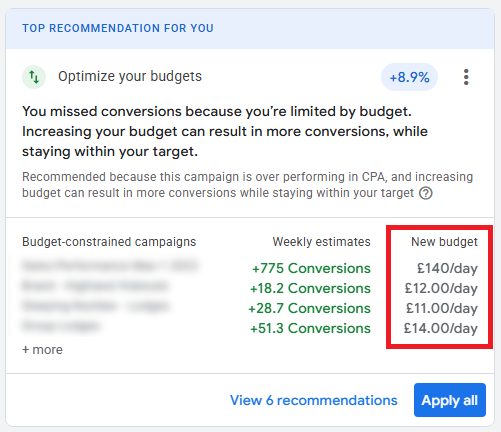
The suggestion to “Raise your budgets” is a very common recommendation in Google Ads. Google’s algorithms love to project how many extra clicks and conversions you could get if you just injected more cash. However, raising your spend on a campaign that isn’t properly optimised simply accelerates your wasted ad spend. Efficiency should always come before scaling. If your campaign has underlying issues – like poor keyword intent or a website that is hard for users to navigate – throwing more money at it won’t fix the problem. You might want to consider a proper Website Audit or looking into Conversion Rate Optimisation before increasing your daily spend for these campaigns.
Loosening Your Profitability Margins
If you are already running a mature Smart Bidding campaign, Google will frequently suggest raising your Target CPA or lowering your Target ROAS to capture more traffic volume. In plain terms, Google is asking you to accept less profitable conversions. While this might result in you getting a few extra sales or leads, it often pushes completely past your actual financial break-even points. Your spending and conversion targets should be dictated by your actual business accounts and margins, not by a platform’s desire for volume.
The Aggressive Performance Max Campaign Push
Whether you run an e-commerce store or a local service business, Google relentlessly pushes the transition to Performance Max. While a Performance Max campaign can be a highly effective tool in some situations when deployed strategically, a completely blind “upgrade” from standard Search or Shopping campaigns can impact a Google Ads account significantly.
Performance Max relies heavily on automation, and lacks controls over spend used between the different networks (Search Network, Display Network and Shopping Network). There are also some indications that Performance Max campaigns can infringe on attribution from other campaigns, if a Performance Max ad has been viewed, but later converted via a dedicated Search Campaign.
Conclusion: Why Human Control Outperforms Automation
Google Ads remains one of the most powerful digital marketing tools in the world, but it requires a skilled human hand to guide it, not just a system left on autopilot. True account optimisation comes from a healthy balance between data-driven machine insights and the reality of your online business goals.
By separating the valuable maintenance tasks from the generic, high-spend automated pushes, you protect both your budget and your brand, allowing your business to grow its online presence.
If you are tired of watching your ad spend rise without a corresponding lift in your actual returns, or if you’re not sure if Google Ads is actually working for you, it might be time for a professional review of your Google Ads. Get in touch with us today to explore how our expert Google Ads agency services can bring some human clarity, focus, and genuine business strategy back to your paid campaigns.